The French art of living has its website Live in France like the French

STORY

PICTO GOURMAND Created with Sketch.

Mont Blanc: history and recipe of an iconic winter cake

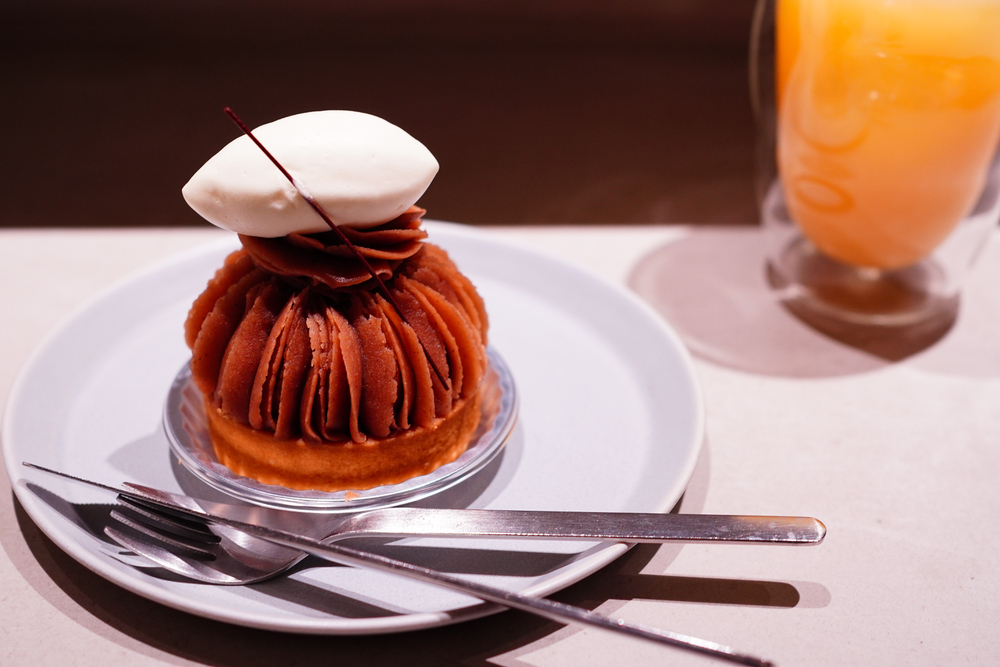
Sometimes all it takes is a dessert to conjure up a whole world of imagination. Mont Blanc is made up of snow-capped peaks, cozy lounges, and cups of steaming hot chocolate. Recognizable by its strands of chestnut cream delicately placed on a meringue and topped with whipped cream, this cake is said to have originated in the 19th century between France and Italy. A historic signature of the legendary Angelina tea room, it embodies a certain idea of gourmet refinement. 

The origins and history of an iconic winter cake

The name of this dessert refers directly to the highest peak in the Alps. Its conical shape evokes a snow-capped summit and its light color is reminiscent of alpine landscapes, while the use of chestnuts in its recipe suggests that it originated between Savoie and Piedmont, two regions where this large chestnut is consumed in simple and nourishing forms.

Originally, the Mont-Blanc was a rather rustic pastry with a meringue base, a simple, slightly sweetened chestnut purée and, depending on the version, a little cream. Its transformation came when it was added to the menu at the Angelina tea room when it opened in 1903. Frequented by the Parisian elite, artists, and the elegant ladies of the Belle Époque, the establishment on Rue de Rivoli quickly became synonymous with a refined lifestyle where delicacies were enjoyed in a sumptuous setting.

Its Mont-Blanc quickly became a signature dessert: generous and perfectly balanced, it elevates chestnut cream by whipping it into fine vermicelli, which is then carefully placed on top of a crunchy meringue and light whipped cream. Generous without being heavy, precise in its textures, it became an essential part of the Angelina experience and remains, more than a century later, one of the most popular desserts on the menu.

The recipe: simplicity and precision

A tribute to the whiteness and majesty of Western Europe's highest peak, this seemingly simple dessert is actually quite demanding, its success resting on a subtle balance between the quality of the ingredients and the textures of three essential elements:

  • A crispy meringue, made from egg whites beaten until stiff and sugar, cooked slowly to retain its lightness.
  • A creamy chestnut cream, ideally made from candied chestnuts and lightly flavored with vanilla, passed through a fine sieve to obtain the famous, very elegant strands.
  • A lightly sweetened whipped cream, made from very cold whole cream, which adds freshness and sweetness.

Too much sugar would mask the delicacy of the chestnuts and too dense a whipped cream would weigh down the whole, so it is in this balance that the talent of the pastry chef lies. When assembling his Mont Blanc at the last minute, he must also ensure the contrast between crunchy, melt-in-the-mouth and airy textures. 

Conclusion: when tea rooms shape French pastry

Served at teatime, the Mont Blanc is part of a double French tradition: 

  • that of gourmet creations that have become classics after being created or popularized in French tea rooms, from the Opéra to the Paris-Brest, not to mention the Saint-Honoré and macarons. 

  • The tradition of a way of life where people take the time to sit down, savor, and pass on a gourmet heritage in these places that have made pastry an art form.

Even today, Angelina's Mont-Blanc remains the gold standard, copied and adapted around the world for over a century. 

But other Parisian establishments also offer delicious versions of this timeless cake:
  • La Boutique de Cédric Grolet near the Opéra Garnier: revisited and renamed “Fleur pavlova châtaignes,” the Mont-Blanc by the star pastry chef is a feast for the eyes with its chestnut cream petals evoking a floral composition.

  • The Bontemps restaurant (57 rue de Bretagne, 75003) and its Mont Blanc cake on a fleur de sel shortbread base, topped with Aubenas chestnut whipped cream flavored with Earl Grey tea. 

  • Sébastien Gaudard's patisserie (22 rue des Martyrs, 75009) where, for an affordable price (€7), a light, crispy Mont Blanc sprinkled with icing sugar will delight lovers of this symbol of French salon patisserie, elegant and deliciously timeless.


Valérie from Comme des Français