The French art of living has its website Live in France like the French

STORY

Created by potrace 1.16, written by Peter Selinger 2001-2019

Parisian street furniture

Paris is more than just its prestigious monuments. Its charm also lies in the everyday fixtures that dot the sidewalks and intersections: Morris’s columns, Wallace’s fountains, Guimard-designed subway entrances… These elements of street furniture, far from being mere accessories, tell the city’s story and, more than 150 years later, constitute the visual DNA of the French capital for the entire world.

A response to the needs of a modern city

In the 19th century, Paris underwent a radical transformation under the leadership of Baron Haussmann. The city opened up, expanded, and modernized. This metamorphosis was accompanied by a rethinking of public space and the needs of Parisians. Each piece of street furniture had to serve a specific function and address a social or public health need.

Among the fixtures that embodied this new vision for the city, the Morris column arose from a practical problem: putting an end to unauthorized postering that was defacing Parisian facades. This cast-iron tower, conceived in 1868 by printer Gabriel Morris, thus provided a dedicated space for cultural posters and performance announcements.
There were 451 of them in the mid-1870s; today there are 550. With their cylindrical design, which allows for 360-degree readability, and their decorative domes that protect them from the elements, these visual landmarks in the Parisian landscape still look as modern as ever.

The Wallace fountains, meanwhile, emerged in response to a humanitarian crisis: between 1870 and 1872, the siege of Paris during the Franco-Prussian War, followed by the destruction during the Paris Commune, made access to drinking water critically scarce. 
Sir Richard Wallace, an Anglophile living in Paris, financed the installation of these cast-iron fountains designed by Charles-Auguste Lebourg. The sculptor chose 4 figures embodying virtues that aligned well with the purpose of these water sources: Kindness, Simplicity, Charity, and Sobriety. By providing water free of charge to Parisians, the British philanthropist effectively combated both alcoholism and inequalities in access to this essential resource.
The first 40 models were gradually joined by 27 more, always placed at strategic locations throughout the city and featuring their instantly recognizable caryatids in long, draped tunics in the classical style (which some interpret as allegories of the 4 seasons).

Another defining element of Parisian aesthetics, the Guimard metro entrances first appeared in 1900, on the occasion of the World’s Fair and the inauguration of the Paris Metro. 
Their function is clear: to mark and protect the underground entrances while blending harmoniously into the urban landscape.
It’s worth noting that, while today these structures made of iron, cast iron, and glass, which shelter the staircases while allowing natural light to filter through, are among the most recognizable and beloved symbols of Paris, this was not always the case. Deemed too fanciful upon their installation, they fell completely out of fashion when the Art Nouveau style gave way to Art Deco in the 1920s. Gradually replaced by more sober and austere stone or concrete entrances, they were fortunately saved from total destruction thanks to André Malraux (Minister of Culture under General de Gaulle), who designated the last remaining ones as Historic Monuments in 1965. 
Protected and restored, they then became icons of Paris and, in a sweet act of revenge, sometimes even regained their original locations thanks to exact replicas that Hector Guimard would certainly have approved of. 
The choice of green: an aesthetic revolution

Art nouveau emerged as a reaction to the Industrial Revolution, which, at the end of the 19th century, profoundly changed the face of cities. Architects at the time rejected rigid, academic forms in favor of curved lines, often inspired by plants and animals.

A style perfectly exemplified by Guimard's subway entrances:  their sinuous ramps evoke plant stems, the "Métropolitain" signs seem to sprout like flowers, and the whole creates a surprising sense of organic form within an urban environment.

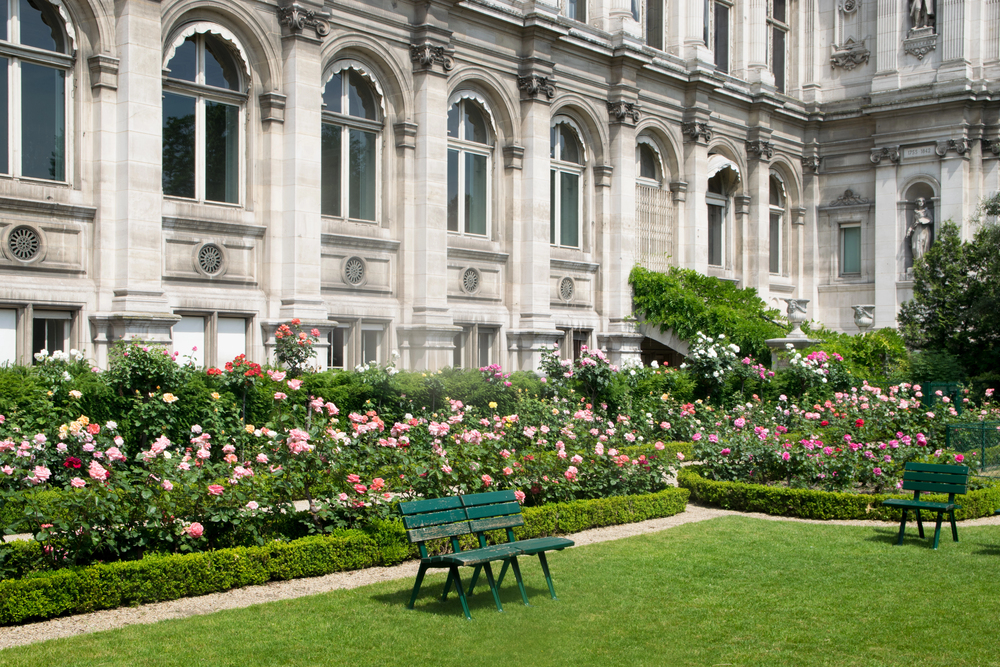
But the unifying element of all this new furniture remains its color: that dark green, sometimes called “railroad car green” or “bottle green, which can also be found on park benches and streetlights in the City of Light. This color choice is said to have been a decision by Napoleon III and Baron Haussmann, who, to create visual harmony with the trees lining the new boulevards and public gardens, reportedly mandated this shade. It was a way to bring a touch of the countryside into the heart of the modernized metropolis, which, since the Second Empire, has adhered to this very specific shade of green, thereby creating an immediately recognizable visual coherence.

An undeniable aspect of identity

Today, Parisian’s street furniture has transcended its original utilitarian function to become a visual language understood internationally.
The Morris column is no longer just an advertising medium: it immediately evokes Parisian cultural life, the performing arts, and the city’s artistic vibrancy. A sign that it has become part of the collective imagination, tourists take just as many photos of it as they do of the Eiffel Tower!

The Wallace Fountains, for their part, tell a story of generosity and resilience. Born out of painful events, their discreet yet constant presence serves as a reminder that Paris is also a city of solidarity and social innovation.

As for the metro entrances, they attract visitors from around the world every year who, particularly at the Abbesses and Porte Dauphine stations, capture these functional works of art in photos. 

In a world where standardization looms, these columns, fountains, and metro entrances affirm the uniqueness of the French capital while offering Parisians familiar landmarks throughout the arrondissements.


Valérie from Comme des Français


----

Continue your stroll through Paris with these articles: