The French art of living has its website Live in France like the French

STORY

PICTO GOURMAND Created with Sketch.

The Oyster

An essential part of French gastronomy, the oyster is much more than just a festive delicacy. A symbol of our coastal regions, this mollusk offers a unique sensory experience that varies from one bay to another. From Brittany to the Mediterranean, let’s set out to discover these salty gems, from production to tasting, to understand why they remain, year after year, a refined delight on French tables.

A region, a flavor: a journey to the heart of the shell

With nearly 100,000 tons produced annually, France is Europe’s leading oyster producer. And contrary to popular belief, oyster season isn’t limited to the months ending in “-ber,” even though consumption does indeed skyrocket during the holiday season (when the flesh is at its firmest and creamiest).

One of the keys to its enduring success is surely its ability to reflect the taste of its place of origin, as our coastlines offer an incredible diversity of flavors. Each region brings its own signature:
  • Brittany (Cancale, Morlaix). This is the realm of the Pacific oyster (Crassostrea gigas). Characterized by a sturdy shell and firm flesh, it offers a clean, briny flavor, sometimes with nutty notes. An oyster with character, perfect for purists.
  • Normandy (Isigny, Courseulles). Renowned for their finesse and subtle taste of hazelnut and crème fraîche. 
The phytoplankton-rich waters of the Baie des Veys produce elegant, less salty oysters that are very popular with beginners.
  • Arcachon Bay (near Marennes-Oléron). Here, you’ll find the famous Fine de Claire and the prestigious Spéciale de Claire. Matured in shallow basins (the claires) where a microscopic algae (blue navicular) thrives, they acquire this unique green color and a powerful, metallic, and lingering taste. 
  • Mediterranean (Bouzigues, Étang de Thau). Raised in warmer, less salty waters, these oysters are often rounder on the palate, with tender flesh and vegetal or floral notes. They hold up very well when cooked (gratin, for example).

Regardless of their origin, this healthy product, rich in minerals (zinc, iron, iodine) and low in calories, is the result of the work that many local oyster farmers perform daily. 

The art of tasting

To enjoy an oyster like a seasoned French connoisseur, simplicity is key.
  • Opening. Use a sturdy oyster knife and a folded dish towel to protect your hand. Insert the blade into the hinge (the beak), use a levering motion to open the shell, then cut the adductor muscle. Be careful not to pierce the flesh.
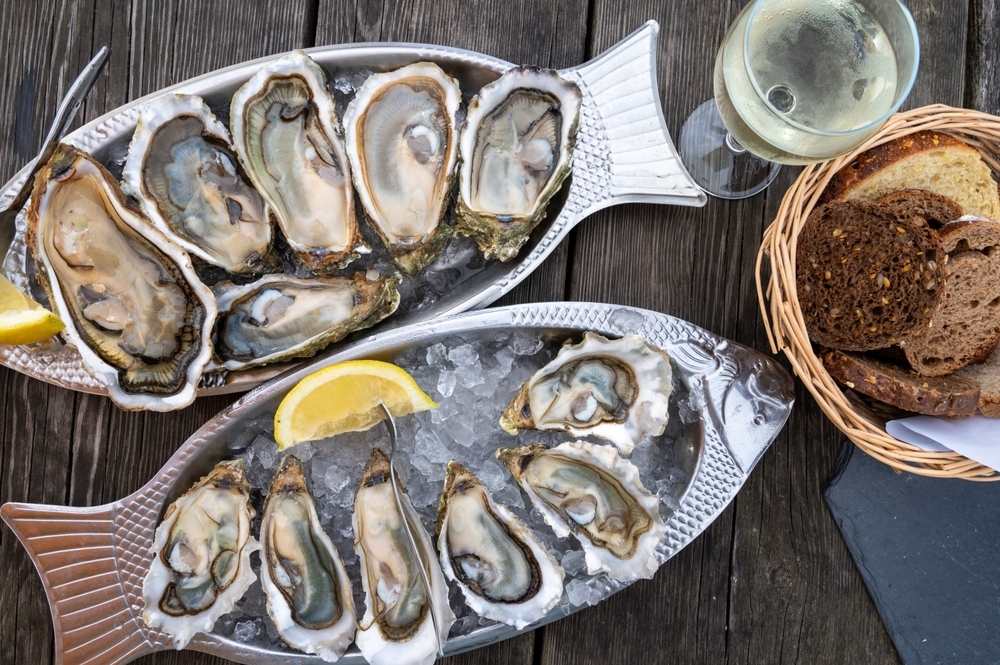
  • Presentation. Serve the oysters on a bed of crushed ice (to keep them cold) or simply on a wooden board.
  • Seasoning. The golden rule is to never mask the flavor.
    • Plain. The best way to appreciate the terroir. 
    • Lemon. A touch of acidity that awakens the taste buds, ideal for oysters with a strong briny flavor.
    • Vinaigrette. Finely chopped shallots, red wine vinegar and a twist of the pepper mill : a classic.
    • Butter. In Brittany, we love to spread a little lightly salted butter on the rye bread.

Where to buy them?

To guarantee absolute freshness and support the local economy, buying directly from local producers is the way to go.

Many oyster farmers sell their oysters directly at oyster farms, at farmers’ markets, or at oyster huts (where you can build your own platter). These are all opportunities to chat with this seafood expert, learn about his work, and choose the size (from No. 5, the smallest, to No. 0, the largest) that suits your taste.

In short, the oyster is a healthy, refined specialty deeply rooted in our heritage.

Whether served at a lavish New Year’s Eve dinner or a picnic by the water, it remains a living testament to the richness of our coastlines.

Recommendations Comme des Français

When to enjoy them? All year round, but opt for fall and winter for a creamier texture. The “-bre” months remain more of a culinary tradition than a health recommendation.
Where to go?
  • In Brittany: the Port de la Houle in Cancale for the atmosphere and selection.
  • In Normandy: the huts at Courseulles-sur-Mer or Isigny-sur-Mer.
  • In Charente-Maritime: the Île d’Oléron and its colorful huts.
  • In the Mediterranean: the quays of Bouzigues on the Étang de Thau.
The local tip. Always ask the oyster farmer for advice on the best “time” to enjoy them. Some oysters are best in the morning, others after spending a night in the cool.
Food and wine pairing: a Muscadet sur lie for Brittany, a Chablis for Normandy, and a Picpoul de Pinet for the Mediterranean.