The French art of living has its website Live in France like the French

STORY

PICTO CURIEUX Created with Sketch.

Discover Fontevraud Abbey

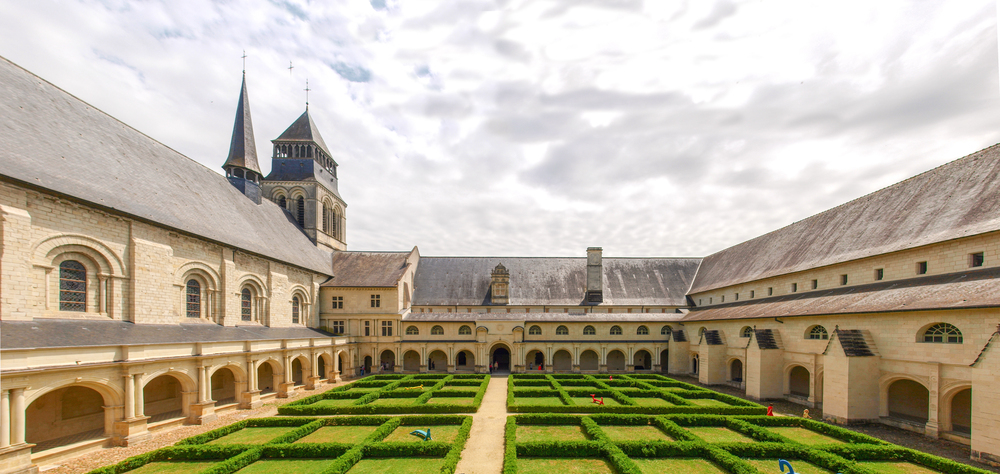
At the border of Anjou, Touraine, and Poitou stands the Royal Abbey of Fontevraud. Listed as a UNESCO World Heritage Site, this vast monastic complex, built in the 12th century, was once a powerful spiritual center and is now a cultural hub where history echoes in every stone. Nestled in a lush green setting, this site, which also served as a prison, is an absolute must-see in the Loire Valley.

From royal necropolis to penitentiary

The story begins in 1101, when the preacher Robert d’Arbrissel founded this religious center, which, unusually for the Middle Ages (and as its name suggests), placed both men and women under the authority of an abbess. This unique form of female leadership endured for centuries, with 36 nuns from distinguished lineages ruling the site with authority between the 12th century and the French Revolution.
But what truly elevated Fontevraud Abbey’s prestige was its role as the royal necropolis of the Plantagenets. It is home to the recumbent statues of this dynasty that shaped Anglo-French history: Henry II, Eleanor of Aquitaine, and their son Richard the Lionheart.
After the French Revolution, the site underwent a radical transformation, becoming a prison that, from 1804 to 1963, housed up to 2,000 inmates, including members of the Resistance during the Nazi occupation. This rich history has shaped the unique identity of this monument, which attracts more than 250,000 visitors each year.

A remarkably well-preserved heritage

A tour of the abbey offers a memorable journey through 6 iconic spaces that reflect its nearly thousand-year history: 

  1. The abbey church, a masterpiece of Romanesque art that houses the famous effigies of the Plantagenet kings.
  2. The cloister, completed in the 17th century, whose classical arcades offer a remarkably serene setting.
  3. The Romanesque kitchens, which, with their imposing stone hood and polygonal structure, reveal the medieval ingenuity that served the needs of the large religious community that dined on site in the 12th century.
  4. The chapter house with its Gothic vaults and refined frescoes.
  5. The refectory and the nuns’ dormitory, which vividly illustrate the discipline of communal life on site.
  6. The monastic gardens, reconstructed using traditional techniques.

Finally, the exhibition on the history of the prison offers insight into this fascinating chapter in the history of this majestic building.

A vibrant cultural destination

Beyond its historical heritage, Fontevraud has been home to a museum of modern art since May 2021. Thanks to the Martine and Léon Cligman donation, this “Musée de France,” located in the main courtyard of the monastic complex, showcases over 800 works where the great names of modern art (Toulouse-Lautrec, Degas, Derain, Delaunay, Vlaminck…) engage in a dialogue with ancient and non-European art.

As part of its ambitious renovation, the abbey has also added first-class hospitality facilities, including a 4-star hotel and a gourmet restaurant led by Chef Thibaut Ruggeri (Bocuse d’Or, 1 Michelin star, 3 Gault & Millau toques). 

This expansion fits seamlessly into the history of this site, built 925 years ago, which has continued to grow ever since, as evidenced by the exhibitions, guided tours, and events regularly held on-site.
Visiting Fontevraud Abbey also means exploring the Loire Valley, a region renowned for its castles and its art de vivre. Located near Angers, in the southern part of the Maine-et-Loire department, this medieval town is brought to life by numerous shops, restaurants, and local organizations. 

Whether you’re a history buff, an art lover, or simply looking to get away from it all, Fontevraud promises an unforgettable experience in the heart of an exceptional heritage site.

Enjoy your visit.

Valérie from Comme des Français


----

Continue reading about these other hidden gems to discover in the Loire Valley