The French art of living has its website Live in France like the French

STORY

PICTO ARTISTE Created with Sketch.

Ferney, Voltaire’s final refuge

In the heart of the 18th century, a turbulent era when the writings of philosophers were beginning to erode the foundations of monarchical absolutism, one name resonates with particular force: Voltaire. While Paris was the stage for his sensational debut and Europe the setting for his exiles, it was in the apparent tranquility of a border estate that François-Marie Arouet found his final refuge: the Château de Ferney. Let’s take a look back at the life of a major figure of the Enlightenment and at this estate, which, for some twenty years, became the European capital of free thought.

A life of struggles, censorship, and exiles

The path that led Voltaire to Ferney was fraught with turmoil. A brilliant but reckless young man, the future inductee into the Panthéon experienced the harshness of royal arbitrariness at a very early age. His sharp pen earned him a stint in the Bastille following the publication of verses mocking the regency of Philippe d’Orléans. Far from breaking his irreverent spirit, this imprisonment only strengthened his resolve. 

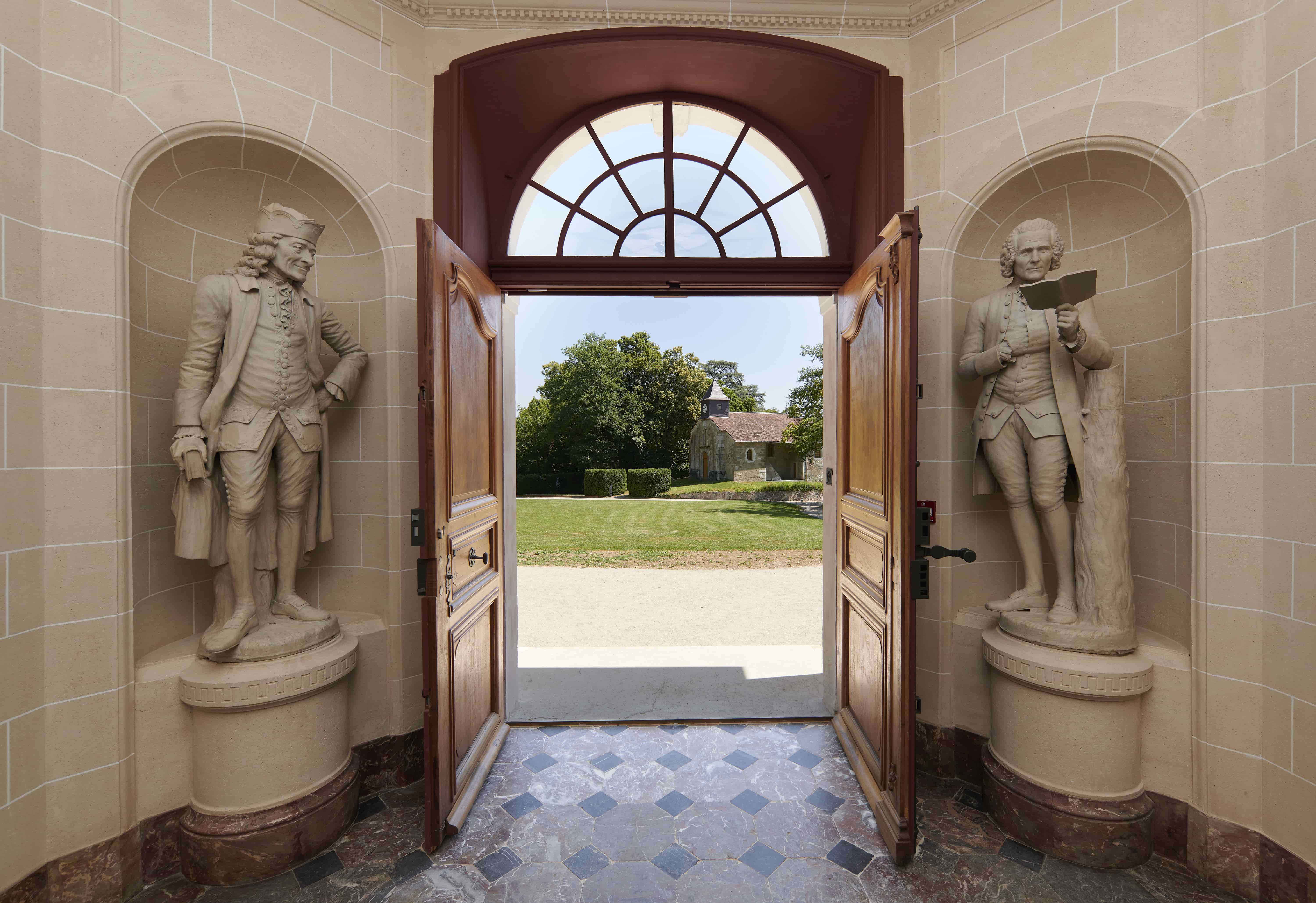
A brilliant polemicist, he would spend his long life (he died at the venerable age of 83!) fighting for individual freedom and tolerance. These struggles earned him some notorious enemies, particularly Jean-Jacques Rousseau, who, ironically, is his neighbor in the Hall of Great Men.

To escape the persecution and censorship that regularly targeted his works, he went into exile in London, stayed in Prussia with Frederick II, and took refuge near Geneva. Everywhere he went, his output was colossal: tragic plays that triumphed on stage, long epic poems, pioneering historical works, and mischievous philosophical tales. A passionate lover of the arts and sciences, Voltaire wrote tirelessly, but his often subversive texts had to circulate clandestinely, printed abroad or under the table to escape the book burnings and bans.

Ferney: the “patriarch’s” refuge

After decades of wandering and court life, the year 1759 marked a decisive turning point. Voltaire acquired the Ferney estate, located on the border between the Kingdom of France and the Republic of Geneva.

This strategic geographical position allowed him to navigate jurisdictional boundaries: when threatened by French authorities, he could take refuge on Genevan soil, and vice versa. For the first time, the defender of victims of religious intolerance or arbitrary rule was at home.

Under his leadership, what was then nothing more than a miserable village and a castle in a pitiful state was transformed, as the philosopher invested his considerable fortune (acquired in part through shrewd speculative ventures) to renovate the estate and bring prosperity to the community. 
There, he built houses, attracted artisans, and turned the château into a must-visit destination for the European elite.

During the final years of his life, kings, princes, diplomats, and intellectuals made the pilgrimage to Ferney to meet the man who shaped public opinion across the Old Continent. There, they staged plays, debated philosophy, and criticized the powerful with undiminished verve.

In this prestigious setting, surrounded by his niece Madame Denis and a court of admirers, Voltaire finally found a well-deserved rest after an eventful life.
It was in this haven of peace, in fact, that he completed “Candide” and wrote a monumental body of correspondence, a true network of influence ahead of its time.

Legacy: from his return to Paris to the Panthéon

His departure from Ferney in 1778 for a triumphant return to Paris marked the crowning achievement of his life. Welcomed as a hero by the crowds, he died a few weeks later, leaving behind the image of a forerunner of the French Revolution. His posthumous influence was immediate and powerful. As early as 1791, the revolutionaries, seeing him as the spiritual father of the new freedom, arranged for his transfer to the Panthéon. He was the second figure, after Mirabeau, to be enshrined in this temple of the nation, cementing his central role in the history of ideas.

Today, the Château de Ferney-Voltaire remains a vivid testament to this human and intellectual epic. Open to the general public, it allows visitors to wander through the very spaces where part of the history of the Enlightenment unfolded. Here, for example, you can explore his preserved bedroom, the salons where he entertained guests from all over Europe, and the armchair where he breathed his last.

To immerse yourself in the intellectual effervescence of a pivotal era and visit this place where the spirit of freedom still seems to linger in the gilded salons, visit the Centre des Monuments Nationaux website.


Valérie from Comme des Français


----
Continue reading about these other inspiring artists’ homes: