L'art de vivre français a son site Vivre en France comme des Français

STORY

PICTO GOURMAND Created with Sketch.

The most popular afternoon snack specialties

Much like the British tradition of “tea time,” many French people enjoy taking a short break in the afternoon to pair a sweet treat with a hot beverage. From the elegant macaron to the ever-popular Petit Lu, here’s a look at the treats that can elevate these brief moments of indulgence.

The art of the gourmet break, by region

Culinary pleasures and the art of sharing are two essential components of French meals, and afternoon tea is no exception. And, as is often the case in the land of Auguste Escoffier, each region has developed its own recipes. Here are a few iconic examples.
The macaron traces its roots in cities like Amiens, Cormery, and Montmorillon, where it was originally made, in the 16th century, with almond paste and honey. Today, its variation as a sandwich made of 2 filled shells is very popular in Paris but is enjoyed far beyond the capital.
Further south, the calisson d’Aix, a Provençal confection shaped like a shuttle, first made in the 15th century, offers a unique blend of candied melon and almonds, perfect with green tea.
On the Mediterranean coast, the navette de Marseille, created in the 12th century by the monks of Saint-Victor, adds a hint of orange blossom to coffee.
In the east and center of the country, gingerbread from Reims, Dijon, or Alsace, a legacy of the Middle Ages, offers comfort with its warm spices, while the pink cookies from Reims, which first appeared in the 17th century, are perfect for dipping, traditionally in champagne, but just as good in a strong cup of coffee.
The variety continues with Lyon’s bugne, a light, dry fritter particularly popular during Carnival, and with the Basque cake, whose thin versions filled with cream or black cherries evoke the southwest.
Finally, it’s impossible to forget the madeleine, so dear to Marcel Proust. The result of an impromptu creation during a dinner hosted for a duke, this small, egg-based cake shaped like a seashell is timeless.
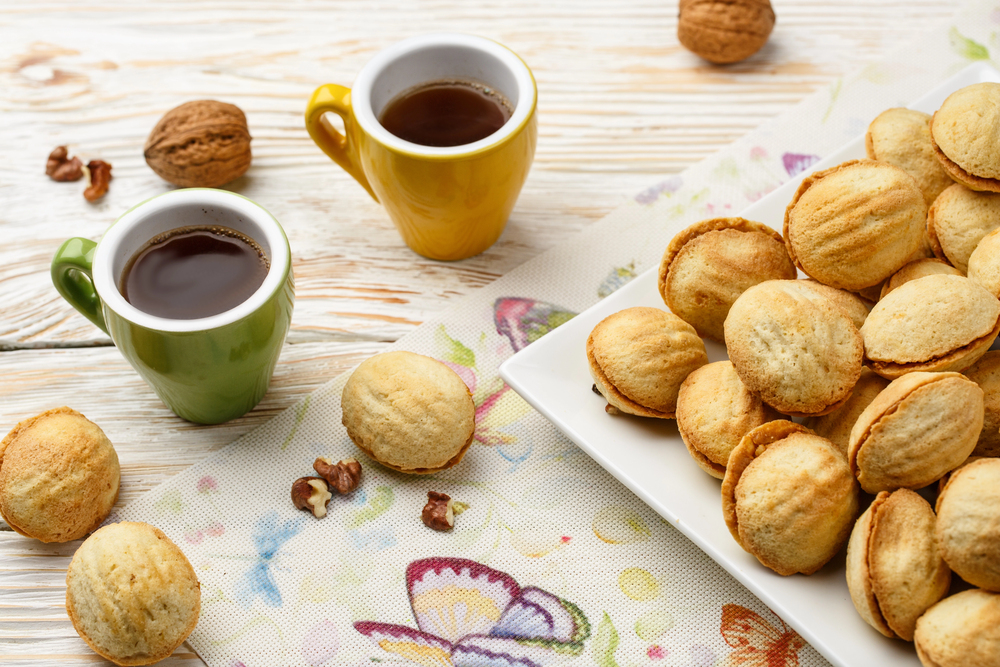
European echoes

This French richness finds an echo in other European tea traditions.
 
While France often favors dry cookies, the United Kingdom celebrates the scone served with clotted cream and jam, or Scottish shortbread made with salted butter.
 
Germany offers the Berliner or the spiced Spekulatius, reminiscent of our pain d’épices, while Italy focuses on the lightness of Tuscan cantuccini, almond cookies designed, like our pink cookies, to be dipped in a sweet wine or an espresso. 

Each culture thus has its own take on sweet accompaniments, with the common thread across these different regions being a love for taking breaks over a comforting or invigorating drink.

Afternoon snack favorites

While these regional and historic specialties represent a precious cultural heritage, contemporary eating habits, particularly during the famous 4:00 p.m. “goûter” remain dominated by tried-and-true favorites. 
Among the most popular cookies in France are a few classics that have stood the test of time:
  • The pure-butter galette, which has long since left its native Brittany to find its way onto tables everywhere,
  • The “Petit Beurre” from Nantes, known for its simplicity and its 24 “teeth,” none of which are left to chance: the 4 along the length symbolize the seasons, the 7 across the width represent the days of the week, and the 52 holes stand for the weeks of the year.
  • The “Petit Écolier,” created by the same Nantes-based cookie maker in 1927, whose little character, unchanged since its inception, is now part of French pop culture.

These are all must-haves that, alongside modern versions of our historic specialties, continue to be a staple of snack time for young and old alike.

Valérie from Comme des Français


----

Continue reading with these delicious articles