L'art de vivre français a son site Vivre en France comme des Français

STORY

PICTO GOURMAND Created with Sketch.

These French culinary specialties with foreign names

French cuisine is renowned for its regional character and authenticity. Yet, when browsing restaurant menus, you often come across names that evoke Spain, Germany, Russia, or Norway. Contrary to expectations, many of these dishes actually originated in France. Here’s an overview of these specialties with misleading names—the result of history, trends, or the creative genius of our chefs.

Savory dishes

Hollandaise sauce
Despite its name, this creamy emulsion made from clarified butter and egg yolks is a classic of French cuisine. It likely originated from a historical mix-up or an adaptation of Dutch recipes by French chefs in the 17th century. Today, it is particularly inseparable from eggs Benedict, an American specialty adopted here at the same time as brunch, that typically Anglo-Saxon breakfast/lunch.

Spanish sauce
One of the five mother sauces of French cuisine, codified by Escoffier, has nothing specific to Spain. Its name is said to derive either from its brown color, reminiscent of the clothing worn by women at the Spanish court at the time, or from a distant origin linked to Franco-Spanish royal marriages. In any case, its base of thickened brown stock is essentially tricolor.
Beef Stroganoff
Although the name pays homage to the Russian Count Stroganov, the version we know today (strips of beef in a cream sauce, served with rice or French fries) was popularized in France during the 20th century. The original Russian recipe was quite different, and it was indeed French cuisine that brought this dish to the world as it is served today.

Cantonese Rice
Invented in France, probably in Paris in the early 20th century in Chinese restaurants that adapted their dishes to local tastes, it combines rice, ham, shrimp, and peas. In Guangzhou Canton, China, this dish does not exist in this form. It is the quintessential “Franco-Chinese” dish.

Sweet treats

Swiss bread and Petits Suisses
Braided brioche, or “mat-shaped” brioche, is a quintessentially Parisian treat, as the French capital draws particular inspiration from Viennese pastries. As for the small fresh cream cheeses, they owe their name to a Swiss manufacturer, Charles Gervais, who partnered with a Norman in the 19th century to produce them in Normandy. Neither, therefore, originates from Switzerland.

Bavarian cream
This light dessert made with custard, gelatin, and whipped cream bears the name of Bavaria, but it was invented and perfected by French chefs, notably Marie-Antoine Carême (“the king of chefs and the chef of kings”) in the 19th century. The name was likely used to evoke a certain Germanic exoticism that was in vogue at the time.
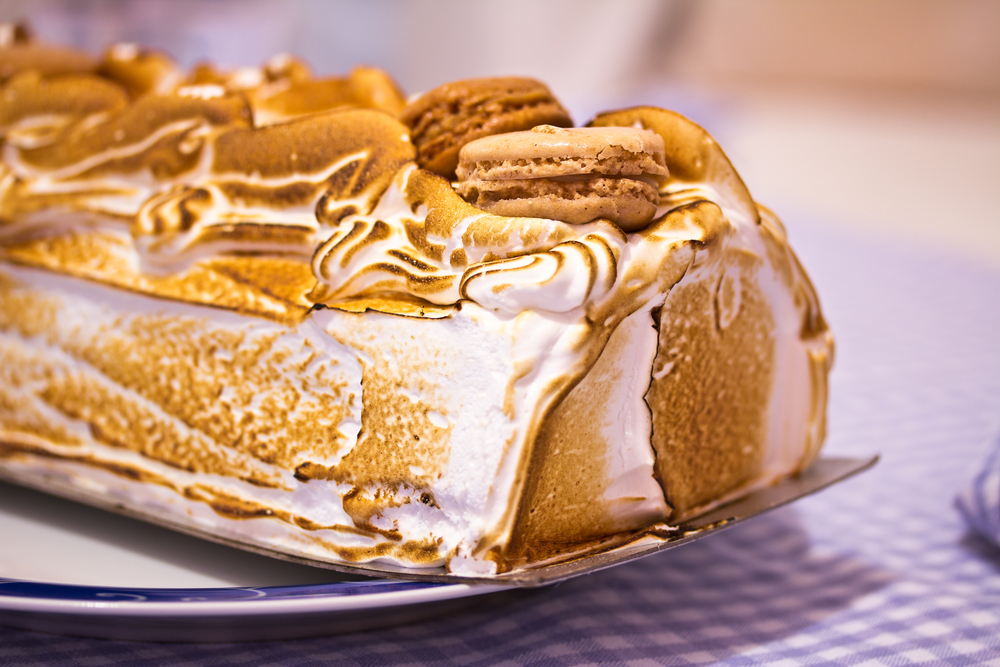
The Norwegian omelette
This spectacular dessert, consisting of ice cream topped with meringue and briefly baked in the oven, was created in Paris. Its name was popularized at the 1867 World’s Fair in honor of the King of Sweden and Norway. And while it may celebrate the French scientific expedition to Scandinavia, this timeless treat is indeed a French technical feat.

Custard
This classic of French pastry, used as a base for ice cream or to garnish desserts, is, paradoxically, rarely eaten in England in this form. The French gave it this name in the 19th century, perhaps out of admiration for the British taste for sweet sauces, although its smooth, fluid texture is a uniquely French characteristic.
Café Liégeois
Also created in Paris around 1870, this frozen dessert topped with whipped cream owes its name to the craze of the time for anything from Liège, Belgium. It has no connection to the Walloon city, however, unlike the Café Viennois, which truly evokes Vienna.


All these names bear witness to eras when exoticism was a mark of prestige. They also remind us that French cuisine has always known how to adopt, adapt, and rename foreign influences to turn them into national classics. No matter what it’s called, when you savor one of these dishes, you’ll know you’re savoring a piece of French heritage.

Bon appétit.

Valérie from Comme des Français


------

Continue your culinary journey with these articles